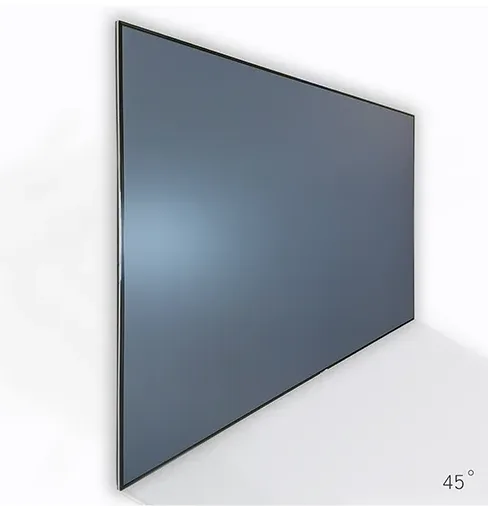

An Ambient Light Rejecting (ALR) projection screen is a specialized type of screen designed to reflect light from the projector while absorbing or rejecting light coming from other sources in the room (such as windows, ceiling lights, etc.).
What is an Ambient Light Rejecting (ALR) Projection Screen?
Unlike traditional white or grey screens which scatter light in all directions, ALR screens have a unique optical structure that directs the projector’s light back towards the audience, making the image appear bright and vibrant even in well-lit environments.
Main Advantages
- Superior Performance in Lit Rooms: The primary advantage is the ability to watch projected content without needing a completely dark room. You can have lights on or have daylight in the room without the image appearing washed out.
- Enhanced Contrast and Color Saturation: By rejecting ambient light, the screen preserves the deep blacks and rich colors produced by the projector. This results in a much higher perceived contrast ratio compared to a standard screen in the same conditions.
- Increased Flexibility for Room Design: You are no longer forced to design a dedicated “home theater” bat cave. ALR screens allow for projectors to be used in living rooms, conference rooms, and other multi-purpose spaces.
- Reduced Eye Strain: Watching a bright projector image in a dark room can cause eye fatigue. With ambient light present, the overall viewing experience is more comfortable for extended periods.
Primary Use Cases
- Living Room Home Theaters: The most common application, allowing projectors to compete with large-screen TVs in typical family room lighting.
- Business and Conference Rooms: Enables clear visibility of presentations, charts, and videos without having to dim all the lights.
- Educational Institutions: Useful in classrooms where teachers need to show content while still having light for students to take notes.
- Digital Signage and Commercial Displays: Used in retail stores, lobbies, and trade shows where controlling ambient light is difficult.
- Gaming and Sports Viewing: Allows for large-screen gaming and sports events in a social, well-lit environment.
Types of Projection Screens with ALR Material
ALR screens are categorized mainly by their technology and required projector placement:
- Long-Throw ALR Screens (Refractive/ Lenticular):
- How they work: They use a series of tiny, vertical lens-like structures (lenticles) to capture and reflect light from projectors positioned at a long distance (typically at the back of the room).
- Best for: Traditional home theater projectors and conference room projectors that are installed on the ceiling far from the screen.
- Short-Throw / Ultra-Short-Throw (UST) ALR Screens (Reflective/ Fresnel):
- How they work: These use a combination of a Fresnel lens (to control vertical light angles) and often a lenticular layer (to control horizontal light angles). They are designed to reflect light coming from a projector placed very close to the screen, right below or above it, while rejecting light from above (ceiling lights) and the sides (windows).
- Best for: Ultra-short-throw projectors (UST projectors). This is a critical pairing, as a standard ALR screen will not work properly with a UST projector.
- CLR (Cinegray Laser Reflective) Screens:
- This is a proprietary name by Elite Screens for their specific type of ALR material, but it has become a common term. It essentially refers to a high-performance, reflective-type ALR screen optimized for UST projectors.
English Description
Ambient Light Rejecting (ALR) Screen
An Ambient Light Rejecting (ALR) screen is a technologically advanced projection surface engineered to maintain image integrity in non-darkened environments. Its core function is optical filtering: it selectively reflects light originating from the projector’s lens while absorbing or diverting ambient light from other directions.
Key Advantages:
- Viewing in Ambient Light: It enables high-quality projection in rooms with windows or artificial lighting, eliminating the necessity for a dedicated dark space.
- Enhanced Image Quality: It significantly improves perceived contrast, black levels, and color vibrancy by preventing ambient light from washing out the image.
- Space Versatility: It allows for the integration of projection systems in multi-purpose rooms like living areas and corporate meeting rooms.
- Comfortable Viewing: It creates a more balanced viewing environment, reducing eye strain associated with a bright screen in a dark room.
Primary Applications:
- Residential living rooms and multi-purpose home theaters.
- Corporate and educational settings for presentations and training.
- Commercial digital signage in bright lobbies or retail spaces.
- Social viewing environments for gaming and sports.
Types of ALR Screens:
CLR Screens: A common industry term (originating from a proprietary technology) for a high-performance, reflective-type ALR screen, typically optimized for use with Ultra-Short-Throw projectors.
Long-Throw ALR Screens: Utilize a lenticular optical layer. They are designed for conventional projectors installed at a distance from the screen (e.g., ceiling-mounted). They effectively reject light from the sides.
Short-Throw / Ultra-Short-Throw (UST) ALR Screens: Utilize a Fresnel optical layer (often combined with a lenticular top layer). They are specifically engineered for projectors placed very close to the screen. They are highly effective at rejecting light from above and the sides.
